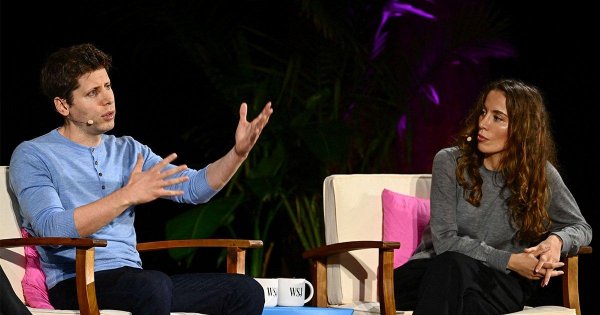
The sudden ouster of Sam Altman from OpenAI's top post has sent ripples through the tech world, but the immediate focus now shifts to his successor. Mira Murati, the company's chief technology officer, has been appointed interim CEO, a move that places a seasoned engineer and product leader at the helm during a period of intense scrutiny.
Murati, an Albanian-born engineer, brings a résumé that includes a notable stint at Tesla, where she joined in 2013 and led development of the Model X. It was during her time at Tesla that she first became interested in artificial intelligence, as the company began experimenting with its Autopilot feature and factory automation—initiatives that would later draw controversy.
After leaving Tesla in 2016, Murati moved to Leap Motion, a hand-tracking startup known for its impressive demos but limited commercial success. In 2018, she joined OpenAI, where she oversaw the rollouts of both DALL-E and ChatGPT, products that have become synonymous with the generative AI boom.
Murati's public statements reveal a leader who acknowledges the disruptive potential of AI while maintaining an optimistic outlook. In an interview with Trevor Noah on The Daily Show last year, she said, “As with other revolutions that we've gone through, there will be new jobs and some jobs will be lost, but I'm optimistic.”
Her communication style has drawn praise from media outlets. Time magazine noted earlier this year that “Somehow, Mira Murati can forthrightly discuss the dangers of AI while making you feel like it's all going to be OK.”
Balancing Innovation and Regulation
Murati has consistently emphasized the need for a deliberate, inclusive conversation about AI's societal impact. In a Time interview, she stressed the importance of bringing in diverse voices, including philosophers, social scientists, and artists, to help shape the technology's trajectory.
She has also expressed support for regulation, telling Time, “It's important for OpenAI and companies like ours to bring this into the public consciousness in a way that's controlled and responsible. But we're a small group of people and we need a ton more input in this system and a lot more input that goes beyond the technologies—definitely regulators and governments and everyone else.”
Her stance on regulation may be tested, as Altman was known to express support for oversight in principle while pushing back on concrete regulatory actions.
Defining AGI and OpenAI's Evolution
On the topic of artificial general intelligence, Murati offered a clear definition in an Associated Press interview in April. “By artificial general intelligence, we usually mean highly autonomous systems that are capable of producing significant economic output,” she said. “In other words, systems that can generalize across different domains. It's human-level capability. OpenAI's specific vision around it is to build it safely and figure out how to build it in a way that's aligned with human intentions.”
Murati also addressed OpenAI's transition from a nonprofit to a capped-profit structure, a move that drew criticism from cofounder Elon Musk. She explained that the change was driven by the high costs of AI development, adding, “We made sure to structure the incentives in such a way that we would still serve the nonprofit mission.”
As Murati steps into the interim CEO role, her leadership will be closely watched. Her background in product development and her measured public demeanor may help steady the ship, but the circumstances of Altman's departure remain unclear. In a telling personal detail, Murati has cited Stanley Kubrick's “2001: A Space Odyssey” as one of her favorite films—a story about an AI that turns on its creators. Whether that's a hint of caution or just a cinematic preference, it adds a layer of intrigue to her new position.










Leave a Comment