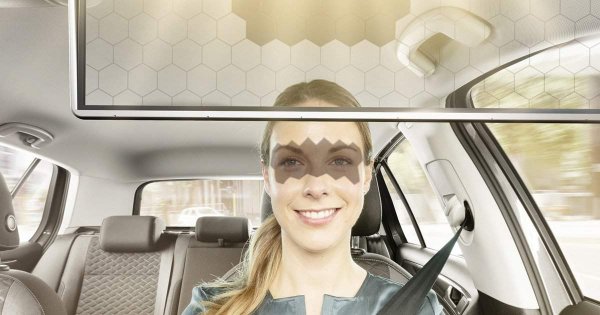
German engineering firm Bosch has developed a prototype sun visor that uses an LCD panel and artificial intelligence to selectively block the sun's glare, leaving the rest of the driver's view clear. The system, called Virtual Visor, is scheduled to be unveiled at the Consumer Electronics Show (CES) in Las Vegas, which opens its doors tomorrow.
Sun glare is a known hazard on the road. According to the National Highway Traffic Safety Administration, thousands of accidents each year are linked to glare conditions. Traditional visors block a large portion of the windshield, forcing drivers to choose between shielding their eyes and maintaining a full view of the road. Bosch's approach aims to eliminate that trade-off.
The Virtual Visor works by using a camera mounted inside the cabin, pointed at the driver's seat. The camera tracks the driver's face and eyes, and the system analyzes shadows on the face to determine exactly where the sun's rays are hitting. It then darkens only the corresponding cells in a honeycomb-patterned LCD panel, while the rest of the panel stays transparent. The result is a visor that blocks the sun's disc but leaves the surrounding scenery visible.
According to a report from CNET, the system is relatively simple to integrate into existing vehicles. It requires minimal power and can leverage hardware already present in many modern cars, such as interior cameras and display controllers. That could make the Virtual Visor an attractive aftermarket or factory-installed option, though Bosch has not announced a timeline for production.
Why This Matters for Driver Safety
The potential safety benefit is significant. Glare-related accidents are often sudden and difficult to avoid, especially during sunrise and sunset when the sun sits low on the horizon. By preserving the driver's view, the Virtual Visor could reduce the need to squint or reach for a conventional visor, allowing drivers to keep their eyes on the road and their hands on the wheel.
The technology also points to a broader trend in automotive design: using artificial intelligence to adapt the cabin environment to individual drivers. Facial recognition is already used in some vehicles for driver monitoring, and Bosch's visor demonstrates how that same data can be applied to improve comfort and safety.
Still, the road to production is not guaranteed. Bosch has not confirmed whether the Virtual Visor will appear in any specific vehicle model, nor has it set a release date. The CES debut will likely generate interest from automakers and suppliers, but as with many concept technologies, the path from prototype to showroom can take years.
For now, the Virtual Visor remains a promising demonstration of how AI can solve a common driving problem. If it reaches production, it could become a standard feature in future vehicles, helping to reduce the number of accidents caused by sun glare.



















Leave a Comment