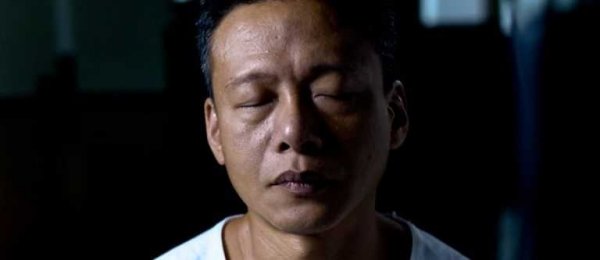
VENICE — For his latest film, Tsai Ming-liang has traded narrative for the human face. The Taiwan-based director premiered Your Face out of competition in the non-fiction section at the Venice Film Festival, a 76-minute work consisting solely of unbroken close-ups of 13 unidentified individuals. Among them is his longtime muse, Lee Kang-sheng, but the rest are strangers, some of whom share remarkable life stories, while others sit in silence or fall asleep.
The film is a deliberate departure from the VR project Tsai presented in Venice in 2017, The Deserted. During that experience, Tsai said he missed the close-up, a fundamental element of cinema that VR lacks. “For me close-up is part of the aesthetics of cinema,” he said in an interview. This desire to return to the close-up became the seed for Your Face.
The project took shape unexpectedly when a cosmetics company approached Tsai to create a promotional piece for a new product in China. Instead of a commercial, Tsai proposed a film of close-ups, which the company funded. The result, however, subverts the commercial intent: the faces in the film belong to people who use no cosmetics. The company, Tsai said, was nonetheless pleased with the outcome.
Tsai’s approach to filmmaking is driven by instinct rather than plot. “These days when I start a project it’s less and less about achieving certain objectives,” he said. “If I feel like doing something, I’ll just do it.” This philosophy is evident in the film’s structure, which avoids title cards, voice-overs, and any explicit narrative thread.
Finding the subjects took more than two months. Tsai and his cinematographer, a young collaborator on his first Tsai film, scoured the streets of Taipei and beyond, seeking faces that appealed to them—working people, often with difficult lives, rather than those who idle. They approached fishermen and factory workers outside the city, but ultimately most subjects came from Taipei for logistical reasons. Convincing them to participate was the greatest challenge. One elderly woman initially refused, saying she was old and ugly; her son persuaded her to take part. Tsai noted that the participants’ trust in him was essential.
Once in front of the camera, the subjects received minimal direction. Tsai gave two instructions: chat for the first half-hour, then sit silently for another half-hour, free to do as they wished. Some dozed off. Tsai shot each person for an hour, and while he filmed 15 people, only 13 appear in the final cut. The editing process was difficult because each face was compelling, and Tsai produced three or four different cuts before settling on the final version.
Music as a Rare Addition
Tsai, who seldom uses music in his films, made an exception for Your Face. The collaboration with Ryuichi Sakamoto began last year when the two met on a Venice beach. Sakamoto, who had served on the Venice jury when Tsai’s Stray Dogs competed, expressed admiration for Tsai’s work. Tsai, a longtime fan of Sakamoto’s, sent him the film, and a month later received 12 compositions. Tsai was initially wary of music that might be too melodic for his style, but found Sakamoto’s work perfectly suited. “It was like he knew exactly what I was thinking,” Tsai said. He used almost all of Sakamoto’s pieces, describing the result as less a score than a performance of imagery and sound, giving the film a sense of presence.
Tsai’s resistance to categorization remains central to his practice. He rejects the distinction between narrative features and documentaries, arguing that only the length of a film matters. Your Face, he insists, defies such labels. “I kept reminding myself to make something that would not fit any such preconceived labels,” he said.
Looking ahead, Tsai hinted at ideas for a film that might more easily fit into a competition lineup, though he remains committed to doing something different. “Mainstream can be guided,” he said, suggesting that his unconventional works may gradually shift perceptions, even at a festival like Venice.



Leave a Comment