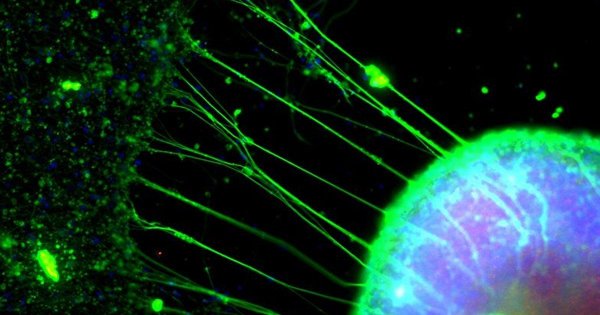
When science writer Philip Ball offered a small piece of skin from his arm to a neuroscience laboratory that cultivates "mini brains," his initial intention was to contribute to research on the biological underpinnings of dementia. Instead, the experiment produced an unexpected outcome: a simplified genetic replica of his own brain began to grow in a petri dish, leading him to confront profound questions about the essence of humanity.
According to a review of Ball's forthcoming book published in Nature, most of the organoids—lab-grown miniature organs—died off shortly after being cultured. However, one survived, taking root and developing into an isolated model of a living human brain. Ball was under no illusion that this organoid was equivalent to a real human brain; for instance, it lacked sensory inputs. Yet, the experience prompted him to reconsider how humanity is defined in biological terms.
In his book, Ball reflects on this personal encounter, stating, "I can no longer map that sense onto any physical description of the human body. I am more conscious than ever of our composite and contingent nature: we are communities of cells." His words capture a shift in perspective that goes beyond the laboratory, touching on the very fabric of what it means to be human.
The book also delves into the historically fraught relationship between biomedical research and societal prejudices. Ball details how each era of scientific inquiry has been shaped by the biases of its time, from racism to sexism, as highlighted in the Nature review. The review, written by Natalie Kofler, emphasizes that the book's central argument is that the notion of pure, objective science is a fallacy. "Perception of science is inexorably linked to culture. It always has been—with implications for both," Kofler writes.
Why This Matters
Ball's experience underscores a growing intersection between advanced biotechnology and philosophical inquiry. As organoid research advances, the line between biological models and human identity becomes increasingly blurred. This story not only highlights the scientific capabilities of growing miniature organs but also raises ethical questions that society must grapple with as such technologies evolve.
For readers, this account serves as a reminder that scientific progress often carries with it unexpected personal and societal implications. Ball's journey from a simple skin donation to a philosophical reckoning illustrates how even the most routine scientific procedures can challenge our deepest assumptions about ourselves.
















Leave a Comment