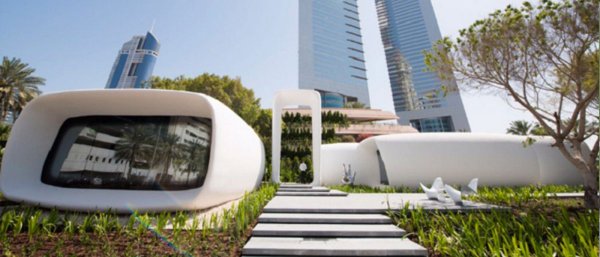
Dubai has added another milestone to its portfolio of futuristic projects: the world’s first fully 3D-printed office building, which went from digital design to completed structure in less than three weeks. The two-story pavilion, named the “Office of the Future,” was printed in 17 days and assembled on-site in just two more, according to officials from the Dubai Future Foundation, which will use the building as its temporary headquarters.
Located on the grounds of the Emirates Towers, the structure represents a practical test of additive manufacturing at architectural scale. The printing was carried out with a robotic arm mounted on a gantry that measured 36.5 meters long, 12 meters wide, and 6 meters high (120 ft by 40 ft by 20 ft). The machine laid down layers of a specially formulated cement mixture developed jointly by firms in the UAE and the United States, producing a building with rounded corners and organic curves that depart from conventional boxy office design.
Officials said the project required only one worker to supervise the printing process, with a crew of seven handling finishing touches and ten electricians and mechanics managing specialized connections and equipment during installation. That lean workforce translated into labor cost savings of up to 50 percent compared with traditional construction methods, a figure that underscores the economic appeal of 3D printing for the building industry.
Why the Project Matters Beyond Dubai
The Office of the Future is not just a novelty. It demonstrates that 3D printing can produce a functional, habitable structure in a fraction of the time and with far fewer workers than conventional methods. Industry analysts see potential for the technology to lower housing costs, especially in regions facing shortages of affordable homes. However, the same efficiency raises concerns about job displacement in the construction sector, which employs millions of workers worldwide.
Dubai’s leadership has framed the project as part of a broader strategy to embrace innovation. At the building’s opening, Sheikh Mohammed bin Rashid Al Maktoum, Vice President and Prime Minister of the UAE and Ruler of Dubai, said: “We implement what we plan, and we pursue actions not theories. The rapidly changing world requires us to accelerate our pace of development, for history does not recognize our plans but our achievements.”
The building will temporarily house the Dubai Future Foundation and Mostaqbal, two entities focused on foresight and future technologies. Their presence in the 3D-printed structure is intended to signal that the city is serious about integrating advanced manufacturing into its urban fabric.
Dubai has a track record of pushing boundaries—it is home to the Burj Khalifa, the world’s tallest building, and has hosted the first aerial drone race. It has also built residential islands shaped like a world map and has announced plans for floating homes and hotels. The Office of the Future fits this pattern of using high-profile projects to test ideas that could later become mainstream.
The broader implications for the construction industry are significant. If 3D printing can be scaled up for residential use, it could reduce material waste, shorten project timelines, and lower costs—benefits that are especially relevant in markets with high housing demand. But the technology also forces a rethinking of the labor market. With fewer workers needed on-site, the industry may need to invest in retraining programs to prepare workers for new roles in machine operation, design, and maintenance.
For now, the Office of the Future stands as a proof of concept. Whether it becomes a template for the future of building depends on how quickly the technology can be adapted to larger and more complex structures, and how societies choose to manage the transition for their workforces.










Leave a Comment