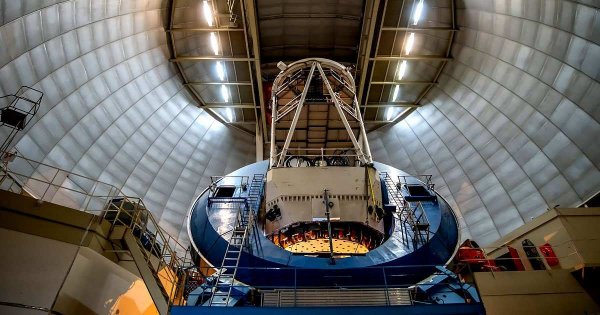
Astronomers have switched on a powerful new tool designed to chart the universe's expansion and probe the elusive force known as dark energy. The Dark Energy Spectroscopic Instrument (DESI), mounted on the Mayall Telescope at Kitt Peak National Observatory, achieved its first light last week, capturing photons for the first time and marking the start of a five-year survey.
DESI's primary mission is to create a three-dimensional map of the cosmos, extending roughly 11 billion light-years from Earth. By measuring the precise distances to millions of galaxies, scientists hope to track how the universe's expansion has changed over time—and, in turn, learn more about dark energy, the mysterious substance believed to constitute about 70% of the universe and drive its accelerating growth.
Unlike earlier surveys that relied on manual or slower methods, DESI uses an automated array of 5,000 fiber-optic "eyes" to capture light from galaxies. Each eye can be repositioned in under a minute, allowing the instrument to analyze 5,000 galaxies every 20 minutes. This rapid cycling will enable researchers to gather data on more than 30 million galaxies and quasars over the survey's lifetime, providing an unprecedented statistical sample.
Bob Nichol, a professor of astrophysics at the University of Portsmouth, said DESI could "spark a revolution in theoretical physics." In an essay for The Conversation, he noted that while most physicists accept dark energy's existence, its exact nature remains unknown. "New instruments like DESI will help take the next step in resolving the mystery," he wrote.
Beyond dark energy, DESI is expected to test long-standing theories of gravity. Nichol explained that the instrument's data could "constrain, and even kill, many theories of modified gravity," potentially offering a decisive confirmation of Einstein's general relativity on the largest cosmic scales—or, conversely, revealing deviations that would upend current understanding.
How DESI Works
DESI operates by splitting the light from each galaxy into narrow wavelength bands, revealing its redshift—a measure of how much the universe has stretched since the light was emitted. This redshift, combined with the galaxy's apparent brightness, allows astronomers to calculate its distance and velocity, building a detailed picture of cosmic expansion.
The instrument's robotic positioners, each holding a fiber-optic cable, can be aimed with precision to collect light from individual galaxies, even when they are densely packed in clusters. This capability is crucial for mapping the large-scale structure of the universe, which is shaped by the competing forces of gravity and dark energy.
What's Next for DESI
Formal observations are scheduled to begin early next year, following a period of calibration and testing. The survey will cover a wide swath of the northern sky, building on data from earlier projects like the Sloan Digital Sky Survey but with far greater depth and speed.
For cosmologists, DESI represents a leap forward in observational power. Its results could refine estimates of the universe's expansion rate, which has been a source of tension between different measurement methods. They may also provide clues about whether dark energy is constant or has changed over cosmic time—a question that lies at the heart of modern cosmology.
As Nichol put it, the instrument's findings could either reinforce the standard model of the universe or open the door to entirely new physics. Either outcome, he said, would be a major advance for science.













Leave a Comment