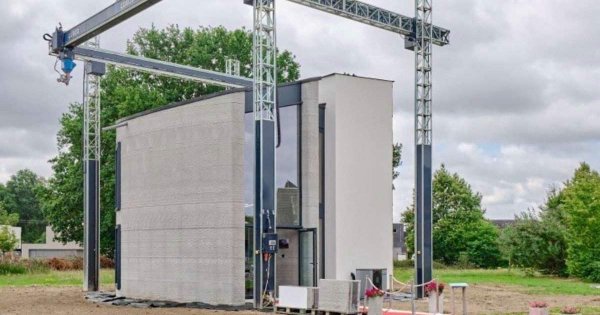
In a demonstration of additive manufacturing's potential for the construction sector, Belgian firm Kamp C has completed a two-story house printed entirely in one piece using a fixed 3D printer. The structure, measuring 980 square feet, stands as the largest of its kind ever produced in a single run, according to the company.
The printer, which spans 32 by 32 feet, operates on the same principle as smaller plastic-printing devices, but deposits a specially formulated concrete mixture layer by layer. This approach offers several advantages over conventional building methods: it accelerates construction, reduces material waste, and could lower overall costs.
Marijke Aerts, project manager at Kamp C, told New Atlas that the concrete's compressive strength is three times greater than that of traditional quick-build bricks. She noted that the use of wire-mesh reinforcement is minimal, and because the printing technology eliminates the need for formwork, the company estimates a sixty percent reduction in material, time, and budget.
The two-story home is currently more of a demonstration than a habitable residence, but it is technically large enough to be occupied. It includes sustainable features such as solar panels and underfloor heating, aligning with Kamp C's focus on environmentally responsible construction.
Industry Impact and Next Steps
Emiel Ascione, also a project manager at Kamp C, described the project to Digital Trends as a statement. "It shows the construction industry the accessibility and potential of this technique," he said, emphasizing that the goal is to encourage wider adoption of 3D printing in building.
The project highlights a growing trend in which 3D printing is used to address housing challenges, from affordability to speed of construction. While this particular house is not yet a model for immediate residential use, it provides a tangible example of what the technology can achieve at scale.
Kamp C's achievement adds to a series of 3D-printed housing projects worldwide, including efforts to create affordable homes for homeless populations. As the technology matures, its role in mainstream construction may expand, though questions about regulatory approval, durability, and cost-effectiveness remain.




















Leave a Comment