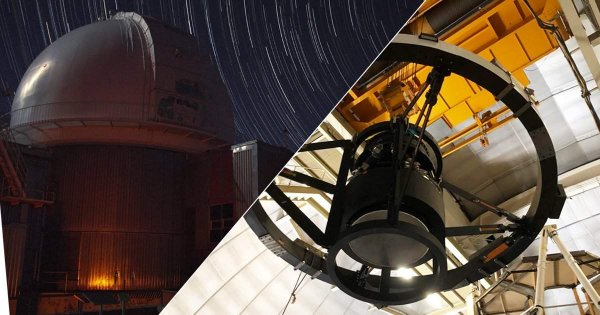
The Kitt Peak National Observatory in Arizona has taken a significant step toward producing the most detailed three-dimensional map of the universe ever attempted. On Wednesday, crews installed the Dark Energy Spectroscopic Instrument, or DESI, a new component designed to measure cosmic expansion with unprecedented precision. Once construction is completed in 2019, DESI will embark on a five-year survey of the night sky, gathering data that could reshape our understanding of dark energy—the mysterious force believed to drive the universe's accelerating expansion.
Dark energy is thought to constitute a substantial portion of the universe, yet its nature remains one of the biggest puzzles in modern physics. DESI's mission is to observe how galaxies have moved over billions of years, providing clues about how this force has influenced the universe's growth. By tracking the velocities of 35 million distant galaxies, scientists hope to measure dark energy's impact more accurately than ever before.
How DESI Works: Redshift and Cosmic Motion
The instrument relies on a phenomenon known as redshift, which is analogous to the Doppler effect in sound. Just as an ambulance siren's pitch changes as it approaches and recedes, light from a moving object shifts in frequency depending on its motion relative to an observer. For galaxies moving away from Earth, their light shifts toward the red end of the electromagnetic spectrum, with the degree of shift indicating their velocity.
While other telescopes have exploited redshift, DESI is designed to do so with greater sensitivity and scale. The instrument aligns 5,000 tiny fiber optic cables to capture light from individual galaxies, allowing it to measure their redshifts in high resolution. This capability will enable researchers to chart the expansion history of the universe over the past several billion years.
The data collected by DESI will not only refine measurements of dark energy but also offer insights into the universe's evolution—from its early state to its current structure, and potentially its future trajectory. Scientists at institutions like the Berkeley Lab, which is involved in the project, anticipate that the survey will address fundamental questions about the cosmos, including the ultimate fate of the universe.
While the installation marks a milestone, the project is not yet complete. Further construction and testing are required before DESI begins its full observational campaign. Once operational, the instrument will join a suite of ground-based observatories dedicated to mapping the sky, but its combination of scale and precision is expected to set a new standard in cosmological research.
For now, astronomers and physicists await the first light of DESI, which promises to deliver a dataset that could transform our understanding of the dark energy that permeates the cosmos.















Leave a Comment