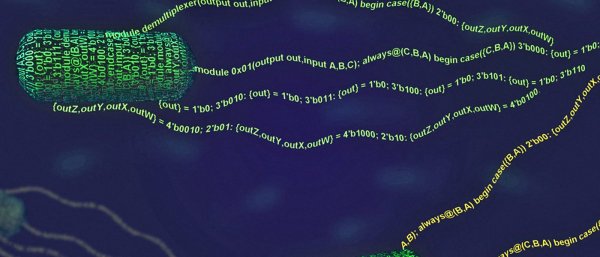
In a development that could reshape the boundaries of biotechnology, researchers at the Massachusetts Institute of Technology have devised a programming language that translates text-based code into DNA sequences, effectively allowing users to "program" living cells to perform specific tasks. The breakthrough, detailed in the April 1 issue of the journal Science, enables the creation of biological circuits that can sense and respond to multiple environmental inputs, with potential applications ranging from toxin detection to agriculture.
Christopher Voigt, a professor of biological engineering at MIT and lead author of the study, described the system as "literally a programming language for bacteria." He explained that a user writes a program in a text-based format, similar to coding for a computer, and the software compiles that code into a DNA sequence. Once inserted into a cell, the DNA sequence acts as a circuit, executing the desired function.
For example, a user could specify that a bacterium should detect the presence of a particular harmful chemical. The compiler would generate a DNA sequence that, when placed in the cell, enables it to respond to that chemical. The result is a custom-designed organism, such as a toxin-sniffing microbe, without the need for the user to have any formal training in genetics or biological engineering.
Democratizing Genetic Engineering
One of the most notable aspects of the new language is its accessibility. The designers intend to make the user interface available on the web, allowing anyone—from high school students to seasoned researchers—to design and order DNA sequences. "You could be a student in high school and go onto the Web-based server and type out the program you want, and it spits back the DNA sequence," Voigt said.
The language is based on Verilog, a widely used hardware description language for programming computer chips. The MIT team adapted it to handle the complexities of cellular environments, incorporating logic gates that can be integrated into a bacterial genome. Currently, the system is tailored to the E. coli genome, but the researchers are working on a version that would allow a single code to be translated for use in other organisms.
The speed of the process is a significant improvement over traditional methods. DNA circuits that once took years to design and build can now be generated almost instantly, reducing the time from concept to implementation to the click of a button.
Applications and Implications
The potential applications are wide-ranging. The researchers are exploring practical uses, including ingestible bacteria that aid in lactose digestion, bacteria that colonize plant roots and produce toxins to deter insect pests, and self-regulating yeast strains that halt fermentation when harmful byproducts accumulate.
Beyond these specific uses, the technology is part of a broader trend in synthetic biology that includes tools like CRISPR, which allow for precise genetic modifications. Together, these methods compress the timescale of evolution from geological epochs to daily operations, giving humans greater control over the biological traits of organisms. Whether this level of control is a responsibility the species is prepared to handle is a question that remains open.
The MIT team's work represents a step toward what some call "living technology," where biological systems are designed and engineered as readily as electronic ones. As the field advances, the ability to program cells could become as commonplace as writing software, with implications that are only beginning to be understood.














Leave a Comment