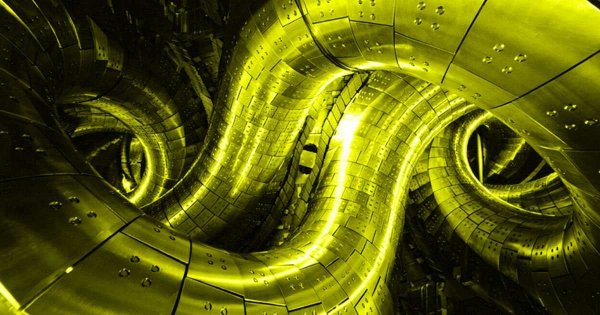
As the global push for practical fusion energy intensifies, researchers at the Princeton Plasma Physics Laboratory (PPPL) have outlined a new diagnostic approach designed to keep volatile plasma in check within next-generation reactors. The proposed technique, detailed in the journal Plasma Physics and Controlled Fusion, leverages electron cyclotron emission (ECE) data to track temperature, stability, and the behavior of the magnetic field that confines the superheated fuel.
The challenge is acute: current diagnostic systems, built for smaller experimental devices, are not robust enough to survive the punishing conditions inside industrial-scale reactors such as ITER, the multinational facility under construction in southern France. Without reliable monitoring, plasma instabilities could go undetected, potentially damaging the reactor or halting operations.
The PPPL team’s concept centers on using ECE—radiation emitted by electrons spiraling along magnetic field lines—to build a real-time picture of the plasma’s state. By analyzing these emissions, physicists could spot the early warning signs of turbulence or disruptions, giving operators a chance to intervene before the reaction becomes unstable. This marks a shift from passive observation to proactive management, a necessity as fusion experiments grow in size and power.
Why Existing Tools Fall Short
Traditional diagnostics rely on physical probes or fixed sensors that are easily degraded by the intense heat and neutron flux of large-scale fusion reactions. At ITER, where plasma temperatures are expected to reach hundreds of millions of degrees, such components would have a short lifespan. The new ECE-based method, if validated, could replace these fragile systems with a non-invasive approach that reads the plasma’s electromagnetic signature from a distance.
The research, published last month, outlines the theoretical framework and the expected data output. However, the authors emphasize that laboratory validation is the next critical step. Upcoming experiments will test whether the ECE technique delivers the precise, real-time information needed to manage plasma stability under reactor-like conditions.
Implications for Fusion Development
Fusion energy has long been hailed as a clean, virtually limitless power source, but practical realization has remained elusive. ITER, which aims to demonstrate the feasibility of fusion on a commercial scale, is a linchpin of that effort. The success of such projects hinges not only on heating and confining plasma but also on understanding its chaotic behavior. This new diagnostic could provide the missing piece—a way to see inside the reaction without compromising the integrity of the reactor.
While the technique is still in the conceptual stage, its potential impact is significant. If the upcoming tests prove successful, the method could be integrated into future reactor designs, offering a more resilient and accurate monitoring solution. For now, the PPPL team’s work adds a crucial layer to the ongoing quest to harness the power of the stars.
















Leave a Comment