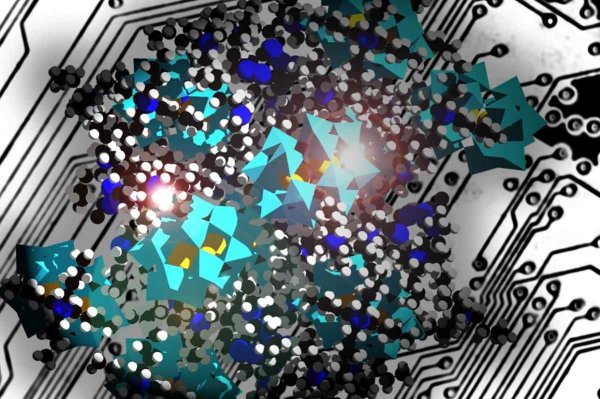
Scientists at the University of Glasgow have designed and synthesized molecules that function like transistors, a development that could eventually allow flash memory cards to store far more data than current technology permits. The work addresses a fundamental limitation in flash memory manufacturing, which has been stuck at a minimum feature size of ten nanometers due to the properties of metal-oxide-semiconductor components.
Transistors are the building blocks of all modern electronics, acting as switches that control the flow of electrical current. In flash memory, they are used to store data by trapping or releasing electrical charges. The smaller the transistor, the more of them can be packed onto a chip, and the greater the storage capacity. But below ten nanometers, conventional metal-oxide-semiconductor transistors become unreliable and are impossible to manufacture with existing techniques.
The Glasgow team, led by Professor Lee Cronin, has taken a different approach: instead of shrinking existing components, they built new molecules that replicate the switching behavior of a transistor. These molecular switches can be synthesized in the lab and, in principle, could be assembled into memory arrays with dimensions far smaller than what is achievable today. Professor Cronin described the potential of the technology as "incredible," though he did not provide specific performance metrics or a timeline for commercialization.
Why This Matters for Storage
Flash memory is ubiquitous, found in USB drives, SD cards, and solid-state drives in laptops and data centers. The push for higher capacity has driven the industry to ever-smaller manufacturing processes, but physical limits are now a serious constraint. Molecular electronics could offer a path around this wall, enabling storage densities that are orders of magnitude greater than current products.
The research, while still at an early stage, is a proof of concept that single molecules can perform the same logical operations as traditional transistors. The next steps would involve scaling up the synthesis and developing methods to connect these molecules into functional circuits. That is a significant engineering challenge, and the Glasgow team has not yet demonstrated a working memory cell, only the molecular building block.
Industry observers note that molecular electronics has been a research curiosity for decades, with few practical applications emerging. However, the specific focus on flash memory is notable because the storage industry is actively seeking alternatives to silicon-based scaling. If the Glasgow molecules can be integrated into a manufacturable process, they could eventually lead to memory cards with capacities that are impossible to achieve with today's technology.
Professor Cronin's group has a track record of innovative work in molecular engineering, and this latest result adds to a growing body of evidence that molecular-scale computing is more than a theoretical exercise. For now, the breakthrough is confined to the laboratory, but it represents a tangible step toward a new generation of storage devices.



















Leave a Comment