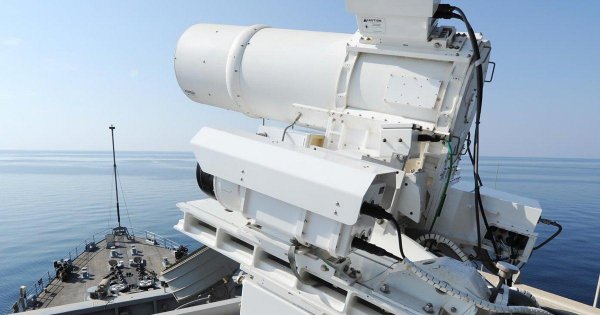
The U.S. Navy is set to integrate a high-energy laser weapon onto one of its destroyers, a move that underscores the military's growing investment in directed-energy technology. The system, developed by defense contractor Lockheed Martin, is scheduled for installation by 2021.
Dubbed HELIOS — short for High Energy Laser and Integrated Optical-dazzler with Surveillance — the weapon will be the first of its kind on a Navy vessel, combining offensive laser capability with long-range intelligence, surveillance, and counter-drone functions. Lockheed Martin spokesperson Michele Evans said the program enhances situational awareness and provides the Navy with more layered defense options.
The 60-kilowatt laser is designed to destroy small boats and unmanned aerial systems, according to Popular Mechanics. It delivers twice the power of an earlier laser system that the Navy deployed on an amphibious transport ship, marking a significant leap in capability.
Costing $150 million, the HELIOS system represents a substantial investment in directed-energy weapons, which are seen as a cost-effective alternative to traditional munitions for certain threats. The Navy's decision to place the system on a destroyer signals a shift toward integrating such weapons into frontline combat vessels.
Why Directed Energy Is Gaining Traction
Laser weapons offer several advantages over conventional arms, including lower per-shot costs and the ability to engage targets at the speed of light. The HELIOS program is part of a broader Pentagon effort to field directed-energy systems across the services, with the Army and Air Force also pursuing laser and microwave technologies.
However, challenges remain, including power generation, thermal management, and atmospheric effects on beam propagation. The Navy's deployment of HELIOS will provide real-world data on how such systems perform in maritime environments.
The installation by 2021 will make the destroyer one of the first U.S. warships equipped with an operational laser weapon, a milestone in naval warfare. While the system's primary role is defensive, its surveillance capabilities could also enhance the ship's intelligence-gathering abilities.
As the Navy continues to modernize its fleet, the integration of HELIOS reflects a broader trend toward incorporating advanced technologies to maintain maritime superiority. The success of this program could pave the way for more powerful lasers on future vessels.




















Leave a Comment