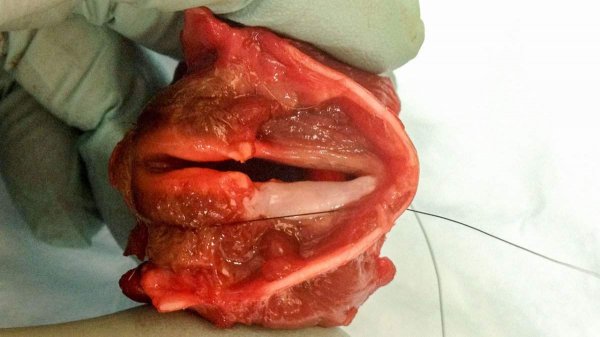
In a first for regenerative medicine, scientists at the University of Wisconsin-Madison have engineered vocal cord tissue in the laboratory that is flexible enough to vibrate and produce sound. The achievement, led by speech-language pathologist Dr. Nathan Welham, could eventually offer a new treatment avenue for patients with voice disorders that currently have no cure.
The research team isolated and purified cells from vocal cord tissue taken from a cadaver and four living patients. These cells were then cultivated on a three-dimensional collagen scaffold. Within two weeks, the cells had formed a tissue that, according to Welham, “felt like vocal cord tissue.”
Vocal cords are two bands of muscle lined with a specialized mucosa. This mucosa vibrates as air passes over it, generating sound. When the mucosa is injured, it can scar and stiffen, leading to a loss of vibration and, consequently, a loss of voice. Existing treatments offer only partial, short-term repair, making this lab-grown tissue a potential long-term solution.
How the Tissue Was Tested
The engineered tissue was able to transmit sound in laboratory tests. It was also implanted into mice that had been engineered to have human immune systems, and it was not rejected. Welham noted that the tissue appears to be “immunoprivileged,” similar to cornea tissue, meaning it does not trigger a host immune reaction.
Despite the promising results, the lab-grown tissue does not yet match the performance of natural vocal cords. Its fiber structure lacks the complexity of adult vocal cords, a difference the researchers attribute to immaturity. They point out that human vocal cords continue to develop for at least 13 years after birth, suggesting the engineered tissue may mature with time or further refinement.
The study’s authors are hopeful but cautious. They emphasize that more testing is required before the technique can move to clinical trials in humans. The work represents a step forward in tissue engineering, but it is not yet ready for patient use.
For the millions of people who suffer from voice disorders—ranging from vocal cord scarring to paralysis—this research offers a glimpse of a future where damaged voices might be restored. However, the path from laboratory bench to bedside is long, and the team stresses that safety and efficacy must be thoroughly evaluated.
This development builds on years of research into replicating the delicate balance of flexibility and strength that vocal cords require. The ability to grow functional tissue in a lab opens the door to studying vocal cord biology in ways that were previously impossible, potentially accelerating the discovery of new treatments.
















Leave a Comment