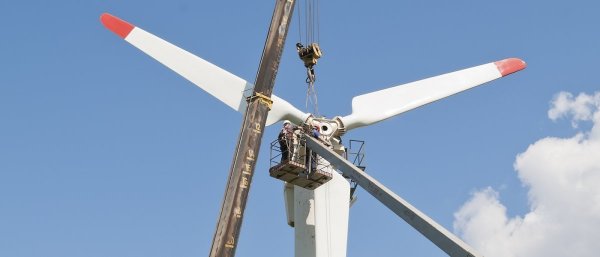
The cost of generating electricity from onshore wind in the United States could fall enough within the next ten years to compete directly with fossil fuel plants, even without government subsidies, according to a market analyst.
Alex Morgan, a wind energy analyst at Bloomberg New Energy Finance, told Insider Climate News that unsubsidized onshore wind is expected to become economically viable against conventional power sources in the coming decade. The projection comes as wind power expands rapidly across the country.
Currently, a new wind turbine is installed every 2.4 hours in the U.S., and in 2016 wind accounted for 5.6 percent of the nation's electricity generation—more than double its share in 2010, according to industry data. The growth reflects both falling technology costs and rising demand from large corporate buyers.
Major corporations including GM, Home Depot, Microsoft, and Walmart have increasingly signed long-term agreements to purchase wind power, drawn by its stable pricing and predictable costs over time. For these companies, renewable energy offers both environmental benefits and financial predictability, making it an attractive option for their energy needs.
The shift toward wind and other renewables is also part of a broader trend. Solar power has become the cheapest electricity source in many markets and now employs more people than Apple, Facebook, and Google combined. In Canada, renewables—including solar, wind, biomass, and hydroelectric—supplied more than half of the country's energy in 2015.
Why Cost Matters for Climate Goals
The affordability of wind energy is increasingly important as climate change accelerates. Making renewables more cost-effective is seen as a key strategy to reduce greenhouse gas emissions, since cheaper clean energy can more easily displace fossil fuel generation.
Industry observers note that no single technology will be enough to address climate change; a mix of solutions is required. Wind power, with its declining costs and growing corporate backing, is positioned as one of the essential tools in that portfolio.
The outlook for wind energy is tied not only to technology improvements but also to continued investment from both the private and public sectors. As more companies and governments commit to renewable energy, the economics of wind are expected to keep improving, potentially leading to a future where fossil fuels are no longer the default choice for new power generation.


















Leave a Comment