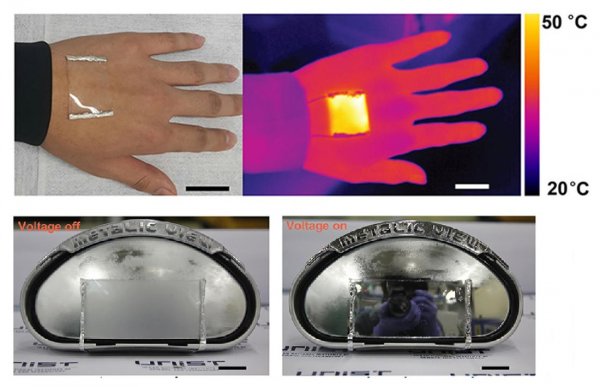
Researchers at the Ulsan National Institute of Science and Technology (UNIST) in South Korea have demonstrated a stretchable, transparent heating device built from a metallic glass electrode. The innovation, described in the journal Nano Letters, could lead to wearable thermotherapy patches or defrosting systems for vehicle windows and mirrors.
Metallic glass, also known as amorphous metal, differs from conventional metals in its internal structure. While standard metals have a highly ordered crystalline lattice, metallic glass features a disordered atomic arrangement similar to that of traditional glass. This structure imparts unusual properties, including flexibility and transparency, which are attractive for next-generation electronics.
The UNIST team, led by Byeong Wan An and colleagues, fabricated the electrode using a copper-zirconium alloy. They deposited the alloy onto a sacrificial polymer web scaffold, creating a tangled network of metallic strands referred to as a "nanotrough network." This web was then transferred onto a flexible, transparent substrate and embedded in polydimethylsiloxane (PDMS), a silicone-based polymer.
When connected to a voltage source, the resulting heating pad reached temperatures up to 180 °C (356 °F) while being stretched to more than one-and-a-half times its original length. Importantly, the resistance remained nearly unchanged during stretching, indicating that the electrode maintained its electrical performance under mechanical strain.
This is the first stretchable electronic device to be made from metallic glass, according to the research team. The material's inherent flexibility, transparency, and stability under hot and humid conditions make it particularly suitable for wearable applications.
From Lab to Potential Applications
The concept of metallic glass dates back to 1960, but its commercialization has been limited by high production costs and processing difficulties. Researchers have also struggled to identify applications where the material's unique properties could be fully exploited. This new study offers a practical use case, demonstrating how metallic glass can be integrated into functional devices.
To showcase the device's potential, the team developed a smartphone-controlled system that allows wireless temperature adjustment. This feature could enable users to regulate a skin patch for thermotherapy, a treatment that applies controlled heat to relieve pain or promote healing.
The researchers are now focusing on developing mass production methods to commercialize the electrode technology. While the current work is at the proof-of-concept stage, the combination of stretchability, transparency, and heating capability opens avenues for future wearable electronics and automotive defrosting systems.
As with any emerging technology, further research is needed to address scalability and durability before widespread adoption. Nevertheless, the UNIST study provides a concrete example of how metallic glass can be harnessed for practical, high-performance devices.


















Leave a Comment