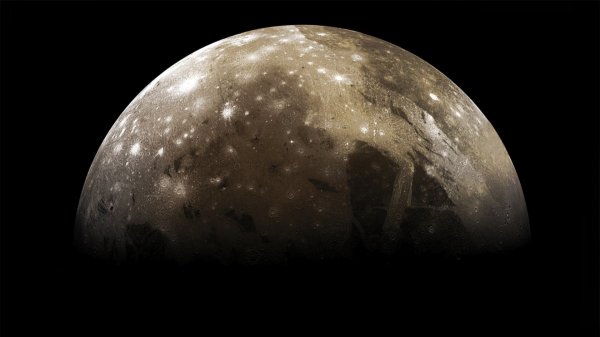
When astronomers point their telescopes at Jupiter's moons, they often focus on Europa and Enceladus, icy worlds that might harbor life in their hidden seas. But Ganymede, the largest moon in our solar system, has its own secrets—including an ocean that holds more water than all of Earth's oceans combined. This discovery, made possible by observations of the moon's auroras, has placed Ganymede firmly on the map of potentially habitable worlds.
Discovered by Galileo Galilei in January 1610, Ganymede was the first moon found orbiting another planet. With a diameter of over 3,200 miles (5,200 kilometers), it is larger than Mercury and three times the size of Earth's moon, though still less than half of Earth's diameter. According to NASA, if Ganymede orbited the Sun instead of Jupiter, it would qualify as a planet.
Ganymede's surface is a mix of ancient, cratered terrain and grooved regions known as "sulcus." These grooves, which can reach thousands of miles in length and stand up to half a mile (700 meters) tall, were long thought to be the result of tensional faulting, where water released from beneath the surface shaped the landscape. But it wasn't until March 2015 that scientists confirmed the presence of a vast subsurface ocean, thanks to observations of the moon's magnetic field.
The key to this discovery was Ganymede's auroras, which are influenced by Jupiter's magnetic field. When Jupiter's field shifts, Ganymede's auroras should rock accordingly, but they didn't move as much as expected. This suggested that something beneath the surface—likely a salty ocean—was dampening the effect. Joachim Saur, a geophysicist who led the research, explained the approach: "I was always brainstorming how we could use a telescope in other ways. Is there a way you could use a telescope to look inside a planetary body? Then I thought, the aurorae! Because aurorae are controlled by the magnetic field, if you observe the aurorae in an appropriate way, you learn something about the magnetic field. If you know the magnetic field, then you know something about the moon's interior."
Why Ganymede's Ocean Matters
The presence of a subsurface ocean on Ganymede is significant because it adds to the growing list of water worlds in our solar system. Along with Europa and Enceladus, Ganymede's ocean could provide the conditions necessary for microbial life. While the moon's atmosphere is extremely thin and not breathable, its interior may be a different story. The moon also has an iron-metallic core that generates a magnetic field, similar to Earth's, which could protect any potential life forms from harmful radiation.
Ganymede's day is the same length as its year, lasting about 172 hours (7 Earth days), a quirk that adds to its intrigue. But the most compelling aspect remains its water, which has been estimated to contain more water than all of Earth's oceans combined.
The European Space Agency's JUICE mission, short for JUpiter ICy moons Explorer, is scheduled to launch in 2022. The probe will study Jupiter and its largest moons—Europa, Callisto, and Ganymede—with a focus on understanding their potential for habitability. The mission is expected to provide more detailed information about Ganymede's ocean and the likelihood of life existing there.
Heidi Hammel, a planetary scientist at the Space Science Institute in Boulder, Colorado, noted, "Every observation we make takes us one step closer to finding a truly habitable environment." As we await JUICE's arrival, Ganymede stands as a reminder that our solar system still holds many surprises, and the search for life beyond Earth is far from over.


















Leave a Comment