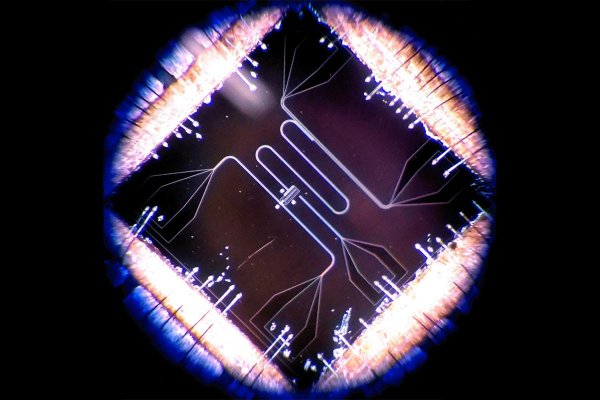
In a development that could refine quantum computing and energy transfer, researchers at Aalto University in Finland have engineered a circuit that manages to be both fast and precise when manipulating quantum states. The work, published in the journal Science Advances, addresses a fundamental trade-off that has long challenged quantum physicists: the need to balance speed against accuracy.
Quantum systems are notoriously delicate. Controlling them in real time requires extreme care, and any rapid manipulation risks introducing errors. The Aalto team, however, has designed a specialized electrical circuit known as a transmon that can execute energy-level jumps at speeds approaching the theoretical maximum while maintaining precision.
The transmon, when cooled to within a few thousandths of a degree above absolute zero, behaves like an artificial atom, exhibiting quantum properties. One such property is that the transmon can only occupy discrete energy levels, akin to the rungs of a ladder. Normally, moving between these levels requires sequential steps, but the researchers discovered that by firing two different microwave photons at the transmon simultaneously, they could induce a jump of more than one rung at once. This leap, previously thought impossible at such speeds, was achieved without losing the system's stability.
Implications for Quantum Computing and Beyond
The ability to control high-speed energy transfers with precision opens new avenues in quantum computing and quantum simulation. The technique could also have applications in other fields, such as improving the charging speed of electric vehicle batteries, though the researchers note that fundamental limits remain an open question.
According to the team, the findings prompt further inquiry into the basic constraints of energy transfer speed. While the immediate focus is on quantum technologies, the broader implications for energy systems are intriguing. The research suggests that future devices could operate faster without compromising accuracy, a combination that has been elusive in quantum systems.
The study was conducted by researchers at Aalto University, a leading institution in quantum technology research. The team's custom-designed transmon circuit represents a step forward in the practical control of quantum states, a challenge that has hindered the development of scalable quantum computers.
As quantum research progresses, the balance between speed and precision remains a central theme. This work demonstrates that with innovative circuit design, the trade-off can be mitigated, offering a path toward more efficient quantum processors and potentially faster energy transfer mechanisms.


















Leave a Comment