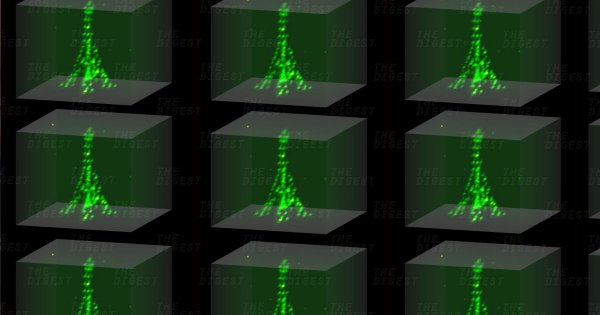
PARIS — In a development that could accelerate the evolution of quantum computers, scientists at the University of Paris-Saclay have demonstrated a technique to arrange individual atoms in three-dimensional configurations, a feat that was previously limited to flat, two-dimensional layouts. The breakthrough, published Wednesday in the journal Nature, offers a new path to scaling up quantum systems that rely on precise atomic control.
Quantum computers operate by manipulating quantum bits, or qubits, which are often realized as individual atoms. Until now, researchers could arrange atoms into one- or two-dimensional arrays using optical tweezers — devices that hold atoms in place with focused laser beams. But the third dimension remained elusive, constraining the complexity of quantum simulations and the number of qubits that could be managed.
The Paris-Saclay team, led by study author Daniel Barredo, overcame this limitation by reflecting a laser off a spatial light modulator — a device that adjusts the intensity of light — and then refocusing the beam to create a three-dimensional lattice of trapping sites. Once the lattice was formed, the researchers populated it with cold rubidium atoms, initially filling about half of the traps randomly. They then used optical tweezers to rearrange the atoms into desired patterns, achieving a final array of 72 atoms.
Beyond Flatland: The Third Dimension
The ability to move atoms in three dimensions is not just a technical novelty. It opens the door to quantum simulations of physical phenomena that require more than two dimensions, such as certain magnetic materials or complex molecular structures. Barredo noted that previous quantum simulations with neutral atoms were limited to around 50 qubits in one- or two-dimensional geometries. With the new method, the team scaled up to 72 qubits, but more importantly, the three-dimensional layout allows for more realistic modeling of real-world systems.
“Accessing the third dimension, as we have achieved in this work, not only allows these qubits to be scaled up (to 72 atoms in our case), it also opens the way to simulating more complex, real-world physical phenomena and materials,” Barredo told Physics World.
The researchers also demonstrated quantum entanglement within the array. By zapping individual atoms with a laser to excite an electron — a process known as Rydberg excitation — they could make pairs of atoms exchange spins, a fundamental operation for quantum information processing. This capability is essential for building quantum gates and performing computations.
Why This Matters for Quantum Computing
The advance addresses a critical bottleneck in quantum computing: the difficulty of scaling up the number of qubits while maintaining control. Arrays of neutral atoms excited to Rydberg states have emerged as a promising platform for quantum simulation, but their utility has been constrained by geometry. This work demonstrates a viable route to three-dimensional architectures, which could lead to more powerful quantum simulators and, eventually, more capable quantum computers.
While the current demonstration is a proof of concept, the team’s approach is a significant step forward. The use of a spatial light modulator to create 3D traps is a relatively straightforward adaptation of existing technology, which may accelerate adoption by other research groups. The Eiffel Tower-shaped array they assembled is a whimsical nod to their home country, but the underlying science is serious: it represents a new degree of control over the quantum world.
As quantum research progresses, the ability to manipulate atoms in three dimensions could prove as foundational as the development of the transistor was for classical computing. For now, the Paris-Saclay team has shown that the third dimension is within reach, and with it, a broader horizon for quantum exploration.


















Leave a Comment