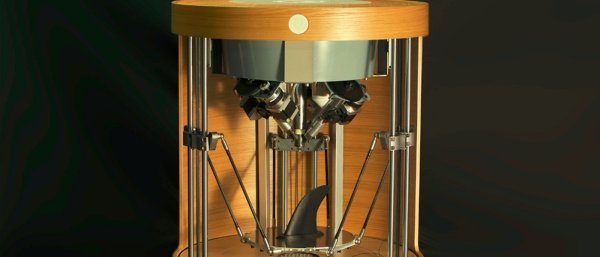
Pollen, a manufacturer known for pushing design boundaries, has unveiled a new 3D printer that pairs high-end aesthetics with technical versatility. Named Pam, the machine features a leather and brass exterior, a departure from the typical industrial look, and is positioned for designers who craft bespoke products.
The printer’s core capability lies in its multi-material system. It can print with up to four different materials or colors simultaneously, using a pellet-based extrusion system supported by filament producers like colorFabb. This allows for combinations of thermoplastics, silicones, and even filled composites, enabling properties such as transparency, flexibility, and food-safe surfaces. The machine can also handle certain metals, as it heats up to 660 degrees Fahrenheit, and can create gradient materials by blending base elements.
Pam’s resolution reaches 40 microns, a level that supports intricate detailing. The company says the system is designed to give serious designers the freedom to experiment with mixed-material products in a single print run, from rigid structures to soft-touch elements.
Software and Remote Control
Accompanying the hardware is Honeyprint, Pollen’s proprietary software. It allows users to control the printer remotely from any device and includes an API for managing printing tasks from a distance. This integration is aimed at streamlining workflows for design studios that require flexibility and oversight.
The price point reflects its premium positioning: €8,000 (approximately $8,900). Pollen has indicated that this could double to €16,000 in 2017, with the first units slated for delivery in April of that year.
While the leather and brass detailing may appeal to those with an eye for style, the functional specs—multi-material printing, high-temperature capability, and software ecosystem—are what set Pam apart in a crowded market. For designers, the ability to prototype with production-like materials could shorten development cycles, though the cost may limit adoption to high-end studios.
Pollen’s move into the luxury segment reflects a broader trend of 3D printers becoming more specialized, targeting professionals who need both performance and a design-forward tool. As the industry matures, machines like Pam could redefine what users expect from a desktop system.














Leave a Comment