Astrophysicist Matthew Caplan of Illinois State University has proposed a machine that could relocate the entire solar system, a concept he calls the Caplan Thruster. The design, developed at the request of the Munich-based YouTube channel Kurzgesagt, is detailed in a paper published in the journal Acta Astronautica. The device would function as a colossal tugboat, pushing the Sun—and by extension, all its planets—to a safer part of the Milky Way.
The need for such an engine arises from potential cosmic catastrophes that cannot be deflected. While efforts to redirect killer asteroids are underway, some threats are far larger. A nearby star going supernova or an unexpected asteroid shower could render planetary defense useless. In those scenarios, moving the entire solar system might be the only viable survival strategy.
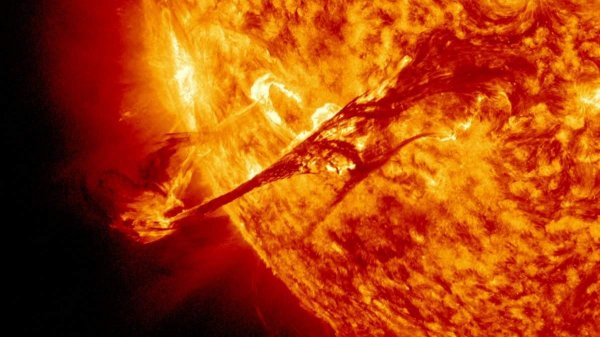
The Caplan Thruster operates on principles familiar from rocketry. Positioned near the Sun, it would use a Dyson sphere to collect solar material, separating it into hydrogen and helium. The helium would be burned in fusion reactors to generate thrust, while a jet of accelerated hydrogen particles would be aimed at the Sun to prevent the device from crashing into it. This dual-thrust mechanism would allow the engine to push the Sun at a speed of about 50 light-years per million years.
While that pace may seem slow, it is sufficient for the types of events that would necessitate such an escape. According to the Kurzgesagt video illustrating the concept, humanity would likely have thousands or even millions of years of warning before a catastrophic cosmic event. This advance notice would give the Caplan Thruster ample time to move the Sun—and Earth—out of the danger zone.
How the Caplan Thruster Works
The engine’s design is a blend of existing astrophysical theory and futuristic engineering. The Dyson sphere, a concept originally proposed by Freeman Dyson, would be used not to capture energy but to harvest mass from the Sun. The fusion reactors would then convert that mass into thrust, similar to how a rocket burns fuel. The additional hydrogen jet aimed at the Sun would serve as a stabilizing force, ensuring the engine does not get pulled into the star’s gravity.
Caplan’s paper, published in Acta Astronautica, outlines the technical feasibility of such a machine. While the engineering challenges are immense, the concept is grounded in known physics, making it a theoretical possibility rather than pure science fiction.
Why Move the Solar System?
The primary motivation for a stellar engine is survival. Unlike asteroids, which can be deflected with kinetic impactors or nuclear devices, events like a supernova are unstoppable. A stellar engine offers a proactive solution: move out of the blast radius entirely. The Caplan Thruster, though slow, could be the key to humanity’s long-term resilience in the cosmos.
The concept has been popularized by Kurzgesagt, a channel known for its animated science explainers. Their video on the Caplan Thruster has brought the idea to a wide audience, sparking discussion about humanity’s future in space.
While the Caplan Thruster remains a theoretical concept, it represents a significant step in thinking about planetary defense. As researchers continue to explore ways to protect Earth, this stellar engine offers a bold alternative: rather than stopping the threat, we could simply move out of its way.



















Leave a Comment